.jpg)
Where constraints used to sit
For businesses operating outside Metro Manila, logistics is rarely framed as a strategic advantage. It is experienced as a constraint that shapes day-to-day decisions. Inventory is held longer than necessary because delivery windows are uncertain. Retailers maintain higher buffer stock to avoid stockouts. Construction timelines shift not because of labor shortages or design issues, but because materials have not yet reached the site. Small and medium enterprises adjust procurement cycles or rely on intermediaries because supply chains are fragmented and unpredictable.
These constraints are not abstract. They translate directly into cost higher storage requirements, delayed project execution, and reduced ability to scale operations. In regions like Western Visayas, these patterns have historically been tied to how cargo enters the system: limited shipping frequency, inconsistent vessel schedules, and variable handling times at port facilities. The Visayas Container Terminal sits at that entry point, where supply first transitions from transport to market distribution.

A port already in use, now being upgraded
The Visayas Container Terminal is not a new development introduced to activate trade. It has long functioned as a working cargo gateway for Western Visayas, handling approximately 100,000 TEUs and about two million metric tons of cargo annually. These figures reflect a port already integrated into regional supply chains, supporting the movement of goods across sectors before any modernization took place.
The current intervention is a ₱2.35-billion modernization program implemented under a 25-year concession, covering upgrades in cargo-handling equipment, terminal systems, and yard capacity. Beyond this BOI-registered investment, the broader redevelopment has been positioned as part of a longer-term effort to enhance Iloilo’s competitiveness as a regional logistics hub rather than a secondary node dependent on larger ports such as Manila or Cebu.
The distinction matters. The project is not designed to introduce activity, but to improve the efficiency of activity that already exists. It addresses how goods move through the system, how quickly they are processed, how consistently they are handled, and how reliably they enter downstream supply chains.
Movement that now follows a schedule
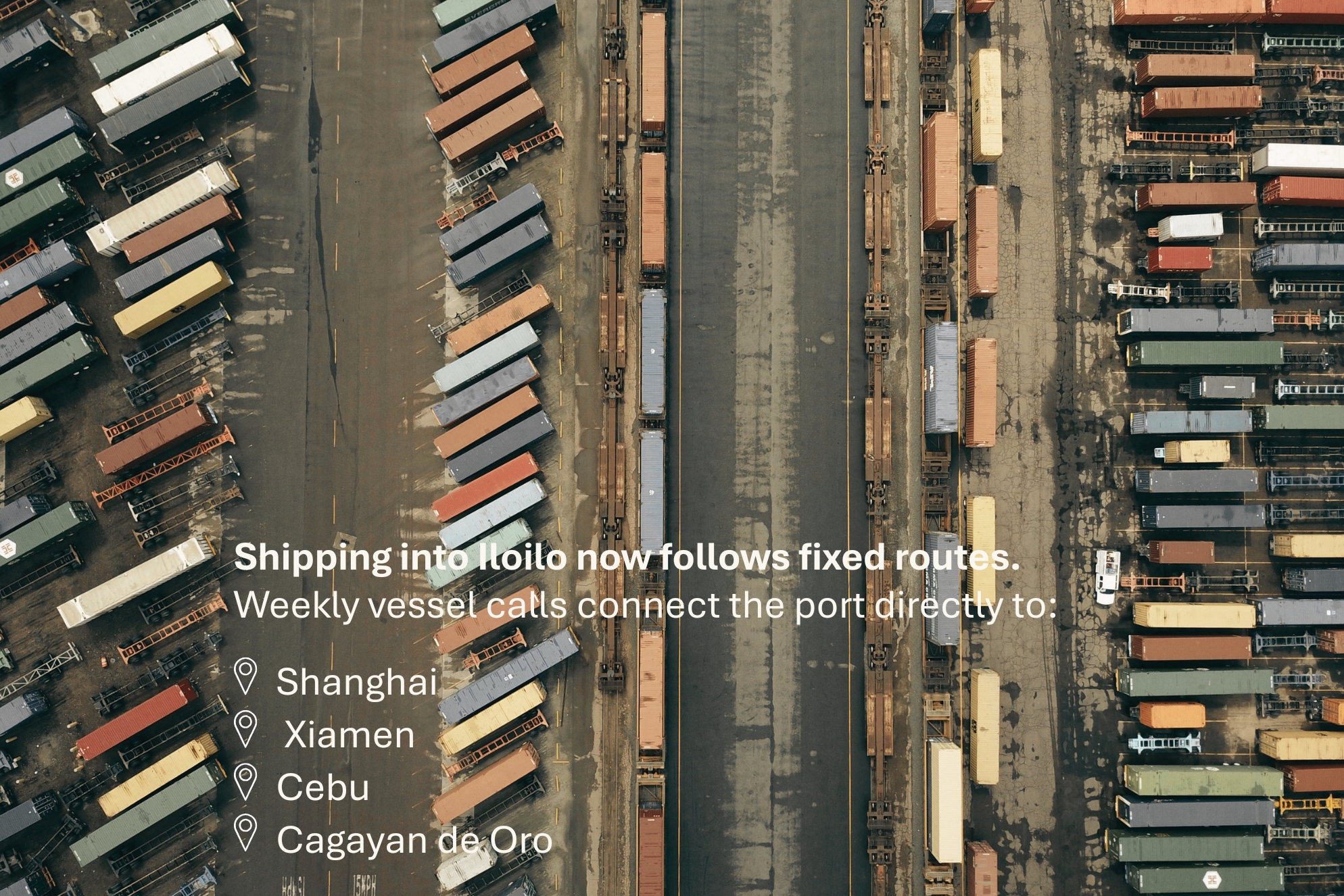
One of the most immediate and measurable changes is the introduction of regular shipping services. Iloilo is now part of a route connecting Shanghai, Xiamen, Cebu, and Cagayan de Oro through weekly container vessel calls. This establishes a consistent arrival pattern for cargo entering the region.
Previously, shipping frequency into regional ports could be irregular, with businesses adjusting to vessel availability rather than operating on fixed schedules. The shift to weekly calls reduces variability in lead times and introduces predictability into supply chains. Cargo arrives within defined intervals, allowing procurement and inventory cycles to align more closely with actual delivery windows.
The addition of direct connections to major trade hubs such as Shanghai and Xiamen also reduces reliance on transshipment through larger Philippine ports. This can shorten overall transit time for certain cargo flows and reduce handling complexity along the route. The impact is not only in speed, but in consistency, goods move within a structured timetable rather than through intermittent access.
Time removed from the system
Handling efficiency at the terminal level has also undergone measurable change. The deployment of mobile harbor cranes each capable of reaching approximately 46 meters and handling loads of up to 100 tons, allows the terminal to service larger vessels, including gearless ships that previously required different handling configurations.
Vessel turnaround time has been reduced, increasing berth availability and allowing more ships to be processed within the same period. Between April and August 2024, foreign vessel calls increased by 16 percent, while foreign cargo throughput rose by 79 percent year-on-year. These figures indicate that improvements in equipment and handling capacity are already affecting both traffic and volume.
The reduction in handling time directly affects how quickly cargo moves from vessel to yard and into transport systems. Goods spend less time waiting at port, which reduces delays downstream. The change is not visible as expansion in infrastructure footprint, but as acceleration in movement.
What moves through it
The composition of cargo passing through the Visayas Container Terminal provides a direct link to the industries it affects. Shipments include cement, grains, construction materials, fast-moving consumer goods, and general merchandise, categories that form the backbone of retail supply, construction activity, and distribution networks.
Outbound cargo has also begun to move through the terminal. Agricultural products from Western Visayas are now being exported through Iloilo, with initial shipments reaching 15 containers and projections increasing to around 45 containers per month. This establishes a two-way flow of goods: imports supplying local demand and exports connecting regional production to external markets.
This dual movement is critical. It positions the terminal not only as an entry point for goods, but as part of a broader trade system linking Western Visayas to regional and international markets.
What changes for retail, construction, and sourcing
Retail is highly sensitive to supply consistency. When goods arrive unpredictably, businesses respond by holding excess inventory, limiting product variety, and adjusting pricing to account for uncertainty. These practices increase operating costs and reduce flexibility.
With more predictable cargo movement, these responses begin to shift. Restocking aligns with shipping schedules. Inventory turnover increases as goods are replenished more frequently. Product assortments expand gradually as supply becomes more consistent. These changes occur over time, reflected in operational adjustments rather than immediate expansion.
Construction activity follows a similar pattern. Materials arriving within narrower delivery windows reduce disruptions between project phases. Sequencing becomes more predictable, allowing project timelines to align more closely with expected supply. This reduces idle time and lowers the risk of delays linked to material shortages.
For small and medium enterprises, sourcing becomes less fragmented. Procurement cycles shorten as delivery schedules stabilize. Reliance on intermediaries may decrease as supply becomes more accessible and predictable. These changes affect how businesses operate, even if they do not immediately change scale.
Trade as system, not event
The Visayas Container Terminal connects Western Visayas to both domestic and international trade routes. Cargo now moves through fixed schedules and improved handling conditions, supporting more consistent import and export activity.
Trade shifts from episodic movement to continuous flow. Export shipments, including agricultural products, move outward through the same system that brings goods into the region. This creates a more stable connection between local production and external markets.
The difference lies in reliability. Goods that move on schedule allow businesses to operate within defined parameters rather than adjust to variability. For exporters, this means more consistent access to shipping routes. For importers, it means more predictable supply chains.

What still depends on the system
The port operates within a broader logistics network that extends beyond the terminal itself. Cargo must move through inland transport systems, warehouses, and distribution channels before reaching end markets.
Processing time at the port is only one component of total delivery time. Bottlenecks in road transport, storage capacity, or administrative processes can limit how much of the terminal’s efficiency translates into end-to-end improvements.
This highlights a structural reality: improvements at a single node do not automatically resolve constraints across the entire system. The effectiveness of the port upgrade depends on how other components of the logistics network adapt and align with it.
What this actually means
The Visayas Container Terminal does not change what people buy, build, or produce. It changes how reliably those activities can be supplied.
Goods arrive on schedule. Handling time is reduced. Delivery windows become narrower.
These are operational shifts, but they affect how businesses plan and execute.
Inventory can be managed with less excess. Construction can proceed with fewer interruptions. Procurement can be aligned with predictable timelines. Expansion becomes less dependent on absorbing uncertainty.
The change is not visible. It is structural. And over time, it defines whether growth can be sustained within the region.
